What is Wrong with Asking: “Who is the best T20 batter?”
Cricket has become more and more inclined to measure performance, especially for the batters lately, due to how they entertain the crowd. Runs, batting average, strike rate, win contribution, and the ICC’s official rankings all attempt to answer one deceptively difficult question: who is the better batter? Here is a solution: Contextual Batting Intelligence!
But there is a fundamental problem in the context of the game.
Not every run scored is worth the same.
Scoring 30 runs while chasing a score of 190 with ten overs remaining is not necessarily equivalent to scoring 30 runs when a team needs only 80 from 72 balls. In this situation, the pressure is less, while wickets are also in hand. A batter who attacks aggressively during a high-pressure phase or powerplay might be aggressive or reckless depending on the opponent, pitch conditions, and match context, but we have enough data about T20 cricket to predict the best possible decision a batter could make given the context of the game.
Rather than treating batting as a collection of isolated statistics, Iqbal attempts to model batting as a sequence of decisions made under changing match conditions, with an emphasis on strike rate due to the nature of T20 Cricket.
And that is what makes the work intriguing.
Contextual Batting Intelligence changes the question.
The central idea behind Iqbal’s Contextual Batting Intelligence is remarkably intuitive for a seasoned cricket fan: instead of asking only what the batter did, what the result was, and how it showed up on this stat sheet, the model asks: was the batter’s decision appropriate for the situation in which it occurred?
The framework, while assessing a decision, incorporates context like wickets remaining, balls remaining, current scoring rate, required scoring rate, innings phase, and the quality of the opposition.
The model consequently moves away from a purely descriptive statistic and toward a decision-theoretic evaluation of batting behaviour.
This distinction matters.
Traditional statistics, the basis on which the current ICC T20 Ranking Model works, can tell us that a player scored 40 runs at a strike rate of 180. They do not necessarily tell us whether those 40 runs represented intelligent risk-taking, unnecessary aggression, or exactly the level of aggression the situation demanded; whether the batter was reckless or timid; or whether the opposition was weak or stronger compared to the batter’s ability,
Iqbal’s framework attempts to capture that missing layer.
Why strike rate still matters enormously
One of the other fascinating aspects of the Contextual Batting Intelligence is that it does not reject strike rate.
The model’s structure naturally rewards efficient scoring because its utility function considers the expected runs generated by an action while simultaneously penalising the probability of losing a wicket.
In simplified form, the core utility can be represented as:
U(a|s) = Ω(b,t) × E[runs|s,a] − λ(s) × P(out|s,a)
- U(a|s) represents the usefulness of a batting action in a particular match state.
- E[runs|s, a ] represents expected scoring from that action.
- P(out|s, a) represents the dismissal risk while acting.
- λ(s) represents how costly losing a wicket is in that particular situation will mean;
- Ω(b,t) adjusts the entire calculation for opposition quality.
This is where the model becomes much more sophisticated than simply calculating strike rate.
A boundary is valuable—but a boundary attempted when the team desperately needs acceleration may be considerably more valuable than the same boundary hit during a comfortable passage of play when the runs are flowing irrespective, and the game is in very much control.
Likewise, a dot ball is not automatically a failure; it might be a necessity on some occasions.
The model therefore effectively asks whether a batter’s choice of aggression was aligned with the demands of that particular situation.
The mathematics behind the model
Iqbal builds a state-dependent framework using a resource ratio based on wickets and balls remaining:
Resource Ratio = (Wₜ + 1) / (Bₜ + 1)
The model then uses different risk parameters for the first and second innings.
For a first innings:
λ(s) = 2.6 × (Wₜ + 1)/(Bₜ + 1)
For a chase, the framework additionally incorporates the difference between required run rate and current run rate, and rewards more, as chasing is under more pressure:
λ(s) = 4.2 × (Wₜ + 1)/(Bₜ + 1) × exp[(RRRₜ − CRRₜ)/(CRRₜ + 1)]
With the pressure term bound to prevent extreme values from dominating the calculation, the model will collapse.
The framework then incorporates opposition strength through an opponent multiplier before calculating the contextual utility of different batting actions.
Finally, a Boltzmann-style probability function converts those utilities into a probability of choosing each action:
π(a|s) = exp(βU(a|s)) / Σ exp(βU(a’|s))
Iqbal then averages the alignment of a batter’s observed decisions across their deliveries to generate the final CBI score.
In other words, the final number is not simply saying:
“This player scores quickly.”
It is attempting to say:
“This player’s observed batting decisions were consistently aligned with the demands of the situations they encountered.”
This is the question that basically needs to be asked at a higher level to make player recruitment in leagues.
Data Reveals Fascinating Stuff
The most compelling part of the research becomes visible when the CBI rankings are placed beside ICC rankings. Iqbal uses a dataset of deliveries from the 2016-2024 T20 World Cup, using Kaggle, to evaluate this model and compares it to ICC rankings too. He uses a minimum of 40 deliveries.
The supplied research dataset produces some striking divergences.
HG Munsey is ranked #1 by CBI but #72 by ICC.
Chris Gayle is #2 by CBI but #24 by ICC.
Andre Russell is #8 by CBI but #149 by ICC.
The divergence becomes even more dramatic for some players. Navneet Dhaliwal, for example, sits at #49 under CBI versus #232 under ICC, while AD Mathews appears at #161 under CBI versus #15 under ICC.
Babar Azam was ranked #186 in CBI compared with #56 in the corresponding ICC ranking in the dataset, highlighting an even sharper divergence between the two systems.
These aren’t minor changes, and people who watch and follow the sport closely know that these divergences show one thing clearly – the impact made in a T20 match.
This demonstrates CBI Index and ICC Rankings are sometimes measuring fundamentally different aspects of the same batting performance.
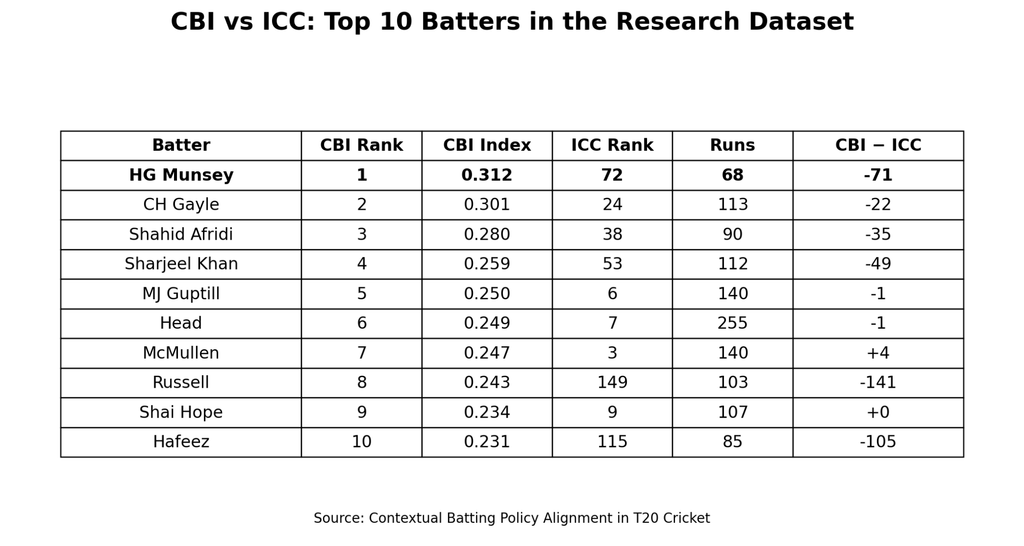
The table above is particularly useful because it demonstrates that CBI is not simply reproducing the ICC list with a different label. It gives completely different results, and those also with what most experts would term as a better parameter to evaluate T20 performances.
That is precisely what an alternative analytical framework should do.
CBI versus ICC: competition or complement?
The ICC ranking system is considerably more established. The ICC describes its player rankings as a points-based system calculated through a sophisticated algorithm that takes circumstances and performances into account. However, this algorithm remains under serious debate now and then, especially when players like Babar Azam or, in fact, even David Malan used to dominate the ranking for years, despite minimal impact.
CBI is attempting something different.
The ICC asks, broadly, how strong a player’s performance has been according to its established ranking methodology.
CBI asks a more contextual question:
How well did the batter’s decisions align with the situation they faced?
That distinction means CBI should not yet be described as a sole, proven replacement for the ICC system.
It is better described as a potential alternative perspective—and potentially a powerful complementary tool for analysts, coaches, franchises, and selectors.
Iqbal’s work gets more interesting here.
He isn’t merely trying to build another leaderboard.
CBI basically is proposing a different methodology for player evaluation.
Check out the latest ICC Rankings
A model that could reshape cricket analytics
The most impressive aspect of Iqbal’s work is ultimately not one formula.
It is the attempt to construct an entire analytical pipeline around a cricketing idea.
The framework combines decision theory, probability, contextual variables, opposition quality, and statistical evaluation into one interpretable value,e which is the C…
More importantly, the research does not pretend that the model is finished and the final product.
Its own discussion identifies limitations and proposes future improvements, including richer state representations, role-specific expert baselines, and potentially learning reward structures through inverse reinforcement learning, incorporating computer vision as well.
Good research does not just announce an obscure result.
It identifies where the model works, where it does not yet work, and what should happen next.
From statistics to decision-making framework
Cricket analytics is moving rapidly beyond averages and totals.
The next generation of performance analysis will increasingly ask questions about decision quality.
Should a batter attack?
Should one rotate strike?
Should they preserve their wicket?
Should they target a particular bowler?
Should the team accept dismissal risk because the required rate has become immensely high?
These are fundamentally decision-making questions.
Contextual Batting Intelligence doesn’t claim that strike rate is irrelevant. It arguably makes strike rate more meaningful by placing aggressive scoring inside a broader framework of risk, resources, and match pressure.
That is the model’s real promise.
It transforms batting evaluation from:
“How much did you score?”
into:
“How intelligently did you score it?”
And if cricket analytics continues moving in that direction, Iqbal’s CBI framework could prove to be an unusually interesting early attempt at building the mathematics for that future.