Imagine that while cleaning your house, you stumble open an old envelope. Upon opening, it hits you like a lightning bolt: the letter is from Sir Don Bradman. Questions start arising in your mind about what would be written and, most importantly, how this ended up here. This is one of the fascinating stories regarding Don Bradman’s letters revealed by fans and journalists you will get to know some of these in this article. So stick around to get a glimpse into this legend’s writing.
Vaibhav Verma discovered Don Bradman’s letter.
Vaibhav Verma writes to ESPN Cricinfo and tells the interesting story of finding Bradman’s letter in his household stuff.
In 2005 he was visiting his home during vacations and moving things from one room to another as his house was being whitewashed. Among his old documents, Vaibhav found an old envelope with a faded color. He turned the envelope to look for the address and it was from Adilate. Vaibhav wonders from whom this could be because he dont know if his family has any relatives in Australia.
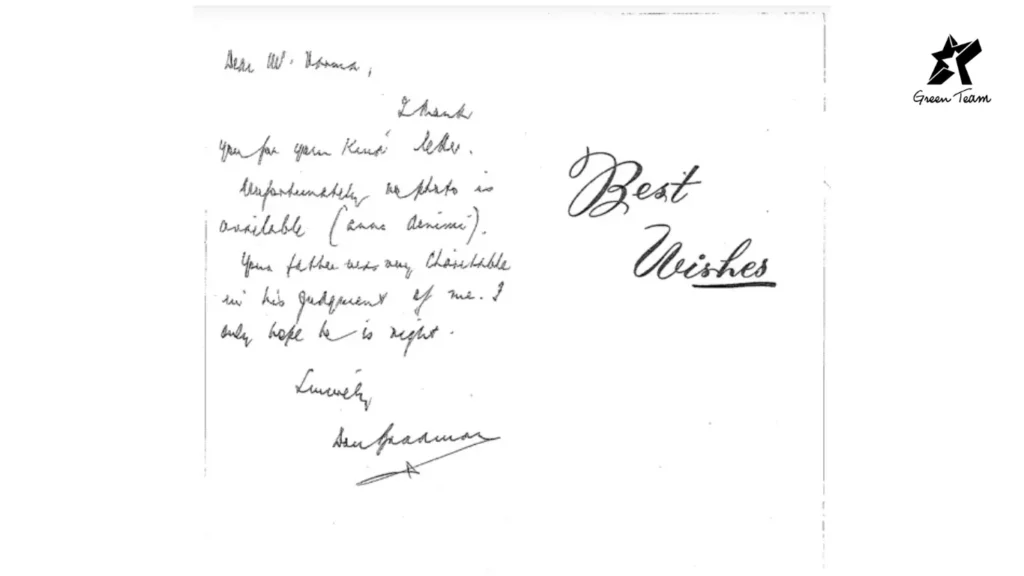
Out of curiosity he opened the envelope and found a note and a greeting card addressed to his father which said: “Dear Mr. Varma, I thank you for your kind letter. Unfortunately, no photo is available. Your father was very charitable in his judgment of me. I only hope he is right.”
Also Read: ICC Champion’s Trophy 2025: PCB to not accommodate a Hybrid Model for India this time
At the end of the note, there was a signature that the writer was not able to recognize upon asking his father he was captivated by the revelation that this was from none other than “Sir Doland Bradman”
The story goes that Vaibah’s father used to hear the stories of Don’s heroics from his father and he found his address and sent him the letter and he was lucky enough to get a reply from the great man.
How Ian Mcdoland Got Copies of 68 Don Bradman’s Letters
Now imagine you have got your hand on copies of 68 different letters from Doland Bradman and you cannot reveal what is written in there. This story involves how Ian Mcdoland got those copies but he can’t reveal the contents of those letters as they are private correspondence.
Ian was at a dinner party where he was having a conversation with a gentleman who was the son of a famous West Indian cricketer he did not reveal which cricketer. During the conversation at one point, they started discussing how great Bradman was. It was evident both were admirers of him. Ian told his friends that he wondered how Bradman must have felt during his last game where he could have achieved the perfect average of 100 but he was not able to do so. To this, his friend replied I know how he was feeling that day.
Ian was surprised and naturally asked how do you know? His friend told him that his father and Bradman were on good terms with each other so had correspondence of letters and he possesses 68 of them.
The next day his friend brought copies of those letters among those was the letter in which Bradman tells what happened on that day when he was playing his last game. Ian promised not to reveal the contents of letters but this did not stop him from revealing how brilliant of a writer he was. Here is the excerpt from Ian Mcdoland’s letter to Cricket Monthly which focuses on Bradman’s writing brilliance.
“I look over the lines as if they were a flow of runs. The strong, no-nonsense writing makes me think what his batting must have been like – I never saw Bradman bat. There are no mistakes or crossings-out and I think of the most error-free batting there ever was. No flashiness, I imagine, well-considered, precise, firm, measured, well-placed – batting legible for all to see and understand. Test match writing. No exclamation marks – no sixes. An accurate flow of words, a clear river of runs. A boundary scored in each efficient paragraph/over. Lucid is the word. The writing is lucid. Might the batting have been lucid too – the most lucid of all time?” Excerpt from Ian Mcdolan’s Cricket Monthly Article published on September 2014
Piers Morgan’s Correspondence with Don Mradman
British Journalist Piers Morgan also has a story to tell about his correspondence with the Don. He recalls the story of him writing a letter to him as a teenager and getting a reply. He had established a regular connection with Bradman and exchanged several letters, some professional and some personal.
The story starts during the 1975 Ashes Piers Morgan was watching the game and he describes Bradman’s aura in his words “What became immediately clear was there was Sir Donald Bradman, and then there was everyone else.”
As a young fan of Don Bradman Morgan decided to write a letter to Don Bradman and he was delighted that he got a response. Piers Morgan says that he discovered that Don Bradman always replies to his younger fans. These are his words describing this event. “I must have been about 12 or 13. I didn’t expect a reply, of course. Amazingly he replied to me with a handwritten letter, beginning ‘Dear Piers’. It was incredible. My sporting hero had written back to me.” ( Excerpt from Piers Morgan’ Article for The Cricketer)
Also Read: Captain Rizwan: The right player to lead Pakistan
This did not stop there, Piers Morgan replied to Bradman’s letter and again got a response, and hence a correspondence was established. This continued during Piers Morgan’s professional career he also requested him to write for the “News of the World” a magazine he was working for at the time. But Don Bradman declined politely saying his journalism days were over.
Piers Morgan Shares his opinion of Don Bradman he says he was not the easy guy he was of a rebellious nature and would always take a stance for what he believed.
“One line I found in one of his letters says: “I still struggle around the golf course, and break my age occasionally. I get very frustrated when I can’t do the things I used to find so simple.” He wrote that when he was 86 he was still breaking his age on the golf course. The letters were warm and informative about what he was up to and who he had seen playing. I never met him. To my mother’s horror, I did invite him to stay during the Centenary Test in 1980, but he said the flight to England was too long.” ( Excerpt from Piers Morgan’ Article for The Cricketer)
Don Bradman’s Letters Caused Controversy
So Far we have discussed positive stories now let’s step into controversial territory. In today’s modern world where public figures have to be careful and avoid causing controversies.
A couple of years back some of Don Bradman’s letters were discovered by a journalist among those there was Bradman’s letter written in 1975 to then Australian Prime Minister Malcolm Fresser congratulating him on being elected as Prime Minister.
One of the things that were not liked by the critics was that Bradman supported capitalism and was critical of his ideologies which endorsed a capitalist system and also wanted the government to educate people about the benefits of capitalism and the free market. Here is the portion from that letter that caused the controversy “The public must be re-educated to believe that private enterprise is entitled to rewards as long as it obeys fair and reasonable rules laid down by the government. Maybe you can influence leaders of the press to a better understanding of this necessity of presentation.”
This caused an uproar against Bradman in Australia’s great and some even went that far as labeling him a “right-wing nut job”
However, some of Bradman’s fans came in defense of him by stating how can you expect some of the modern-day norms and values to be believed by someone in 1975. People should stop this culture of canceling long-dead celebrities.
Bradman Receives An Anonymous Letter During A Game
This is the story of arguably the most famous fan mail sent in the history of cricket.
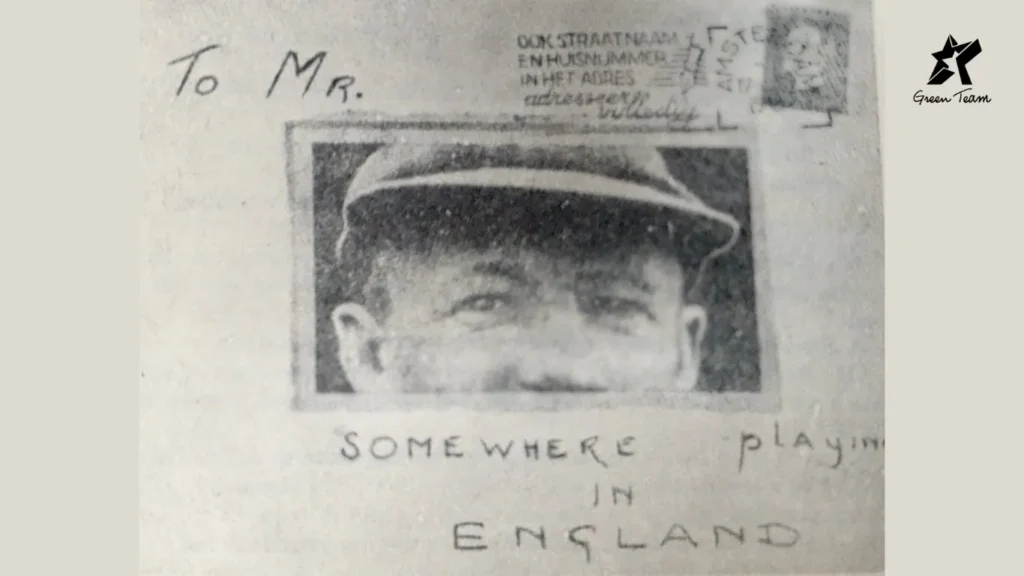
Don Bradman was batting during a match at the Lord’s Cricket ground but the game was interrupted when a mailman showed up on the ground to deliver the letter to Bradman. It was sent from Amsterdam with a picture of the upper half of the receiver’s face and an address written as “Somewhere playing in England.” This incident was recorded in Don Bradman’s biography.