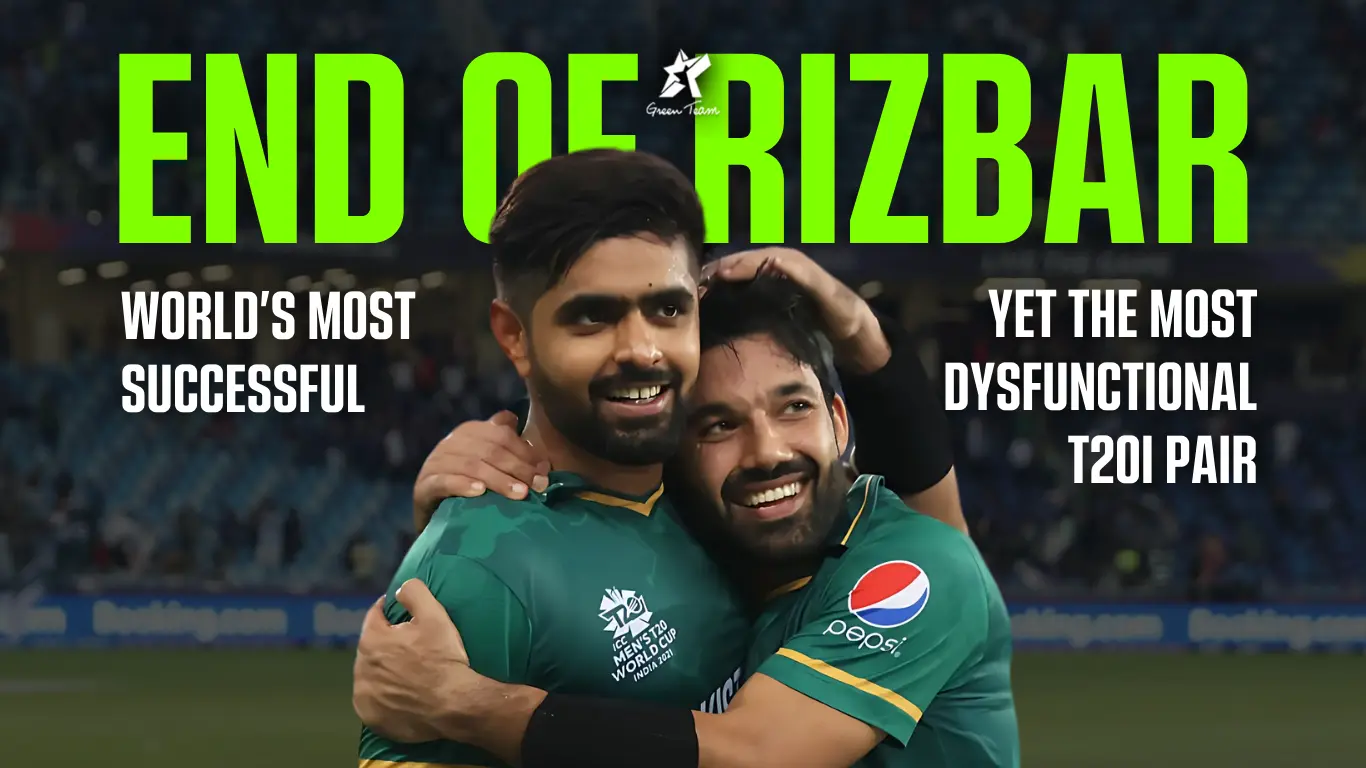
Muhammad Rizwan and Babar Azam opening for Pakistan. That too in Twenty20 cricket. If you had heard this in 2020, you would have laughed at it. But by the end of 2021, you would be clapping for the most successful opening pair ever in a calendar year. Despite success, it was still a dysfunctional partnership in T20Is, especially with the strike rate issue.
Fast forward to March 2025, the end of RizBar. Both batters have finally been dropped from the T20I side. Even though Babar was the most successful batter for Pakistan in T20Is in 2024, despite Pakistan’s horrible performance as a team. And what about Rizwan? Poor guy was just recently appointed as Pakistan’s white-ball captain, only to be removed as their T20I captain after leading them in just four matches.
There can nothing be to say about the Pakistan Cricket Board or its management. Failure in the recent Champions Trophy, an ODI format, saw changes in the T20I squad. The problem does not only lie in players but within the management as well. Unfortunately, that will be looked past as big bosses do not like to be pointed at.
So instead, we observe why RizBar was the world’s most successful yet dysfunctional partnership in T20Is.
Also Read: Babar and Rizwan’s Selfish Decision: Denying Youngsters a Chance at the Top
RizBar – How well was their partnership in T20Is and where they lacked?
Babar Azam and Muhammad Rizwan have established themselves as one of the most successful opening duos, breaking multiple records and repeatedly winning games for Pakistan.
Pakistan’s T20I triumphs have been greatly aided by the productive partnership between Babar Azam and Muhammad Rizwan. This partnership has produced strong starts and established bases for competitive totals. Because of their understanding of one another and reliable play, they are one of the most dreaded opening pairs in world cricket.
In addition to advancing their careers, their record-breaking performances and unwavering consistency have greatly increased Pakistan’s stature in T20I cricket. In 2021, Pakistan won 20 out of 29 games, the most successful year for them in T20Is.
It was successful for the RizBar duo too, amassing 1380 runs in 25 stands at an average of 57.50. They became the first pair to have 1000 partnership runs in a calendar year not only in T20Is but also in all T20s.
Also Read: 2021 – The Year of Mohammad Rizwan in T20s
Until their last stand together in December 2024, the duo has amassed 3,300 runs in 73 innings, averaging 46.47 runs per partnership. This is the highest aggregate for any pair in T20I history. Babar and Rizwan have recorded 10 century stands in T20Is, the most by any batting pair.
As for being the opening pair, they have scored 2522 runs in 56 matches at an average of 46.70, with eight-century stands being the most for any T20I opening partnership in the world.
The duo also became the first pair to score three 100-plus opening partnerships in Men’s T20 World Cups. This includes their iconic 152-0 against India in Dubai 2021, which gave Pakistan its first-ever win against its archrivals in a World Cup match.
RizBar are also the only duo in the world to score 150+ opening partnerships. This includes the highest successful chase in Men’s T20Is, which came against England chasing 203.
Reasons for the End of RizBar
Both Babar Azam and Muhammad Rizwan have come under fire for their strike rates in Twenty20 Internationals despite their outstanding records. Critics say their cautious scoring pace might pressure the middle and lower orders to accelerate their pace. Since Babar and Rizwan have different T20I strike rates (129.12 and 126.62, respectively), there are arguments concerning their willingness to strike and intent at the top of the order.
Pakistan plays conservatively because of concern that quick wickets could reveal their frail middle order, as they frequently rely on Babar and Rizwan to take the innings deep. This lack of aggressive batters following them often causes them to prioritize staying at the crease over accelerating the scoring rate.
Instead of aggressive power striking, both players instinctively assume an anchor role, which maintains stability at the top. Their slower start and fewer boundary shots often result in their use of conventional strokes rather than aggression. Although they are reliable, their desire to bat deep frequently leads to a conservative powerplay strategy.
Babar and Rizwan place a lot of focus on singles, doubles, and strike rotation, which keeps the scoreboard moving but doesn’t always satisfy the needs of modern T20. Early on, Rizwan may have trouble keeping up with the express pace, which affects acceleration. Occasionally, Babar slows down in the middle overs when he is stuck against good spin bowling.
With top teams scoring 9–10 runs per over in the opening six overs, modern T20 batting demands strong starts. However, Pakistan’s opening partnership frequently scores 7-8 runs per over, which puts pressure on the middle order. For instance, their cautious use of the powerplay was questioned during the 2021, 2022 and 2024 T20 World Cups.
Also Read: Experts Blame Rizwan for Babar’s Failure
Is this truly the End of RizBar?
Pakistan are known to hit the panic button quickly if things do not go their way. Just a recent example; Rizwan lost all four T20I matches he led Pakistan to and the panic button was hit. They change the captain from him to Salman Ali Agha and want to have a more “attacking mindset” by dropping Rizwan and Babar. Ironically, Salman’s short T20I career reads; six games, 10 average and 79 strike rate. His overall Twnety20 stats show he averages just a touch below 19 and a strike rate of 116.
Not to disrespect Salman at any cost, since he has been a real gem for Pakistan and played a crucial role in longer formats, but the idea of having him lead Pakistan could be a disaster. Time witnesses that, since the departure of Misbah, players tend to have poor records the moment they become captains. The “genius” behind this decision is flawed and illogical. But only Salman can prove billions wrong. Salman can change not only his own game but perhaps Pakistan’s T20I team as a whole. Only time will tell.
As for Rizwan and Babar, they may come back. They probably will should Pakistan fail to do well under Salman and with the 2026 T20 World Cup a year away. There is a reason why Pakistan is often referred to as “Panic-stan” and the term suits more than ever given the recent circus going on.
Read More: