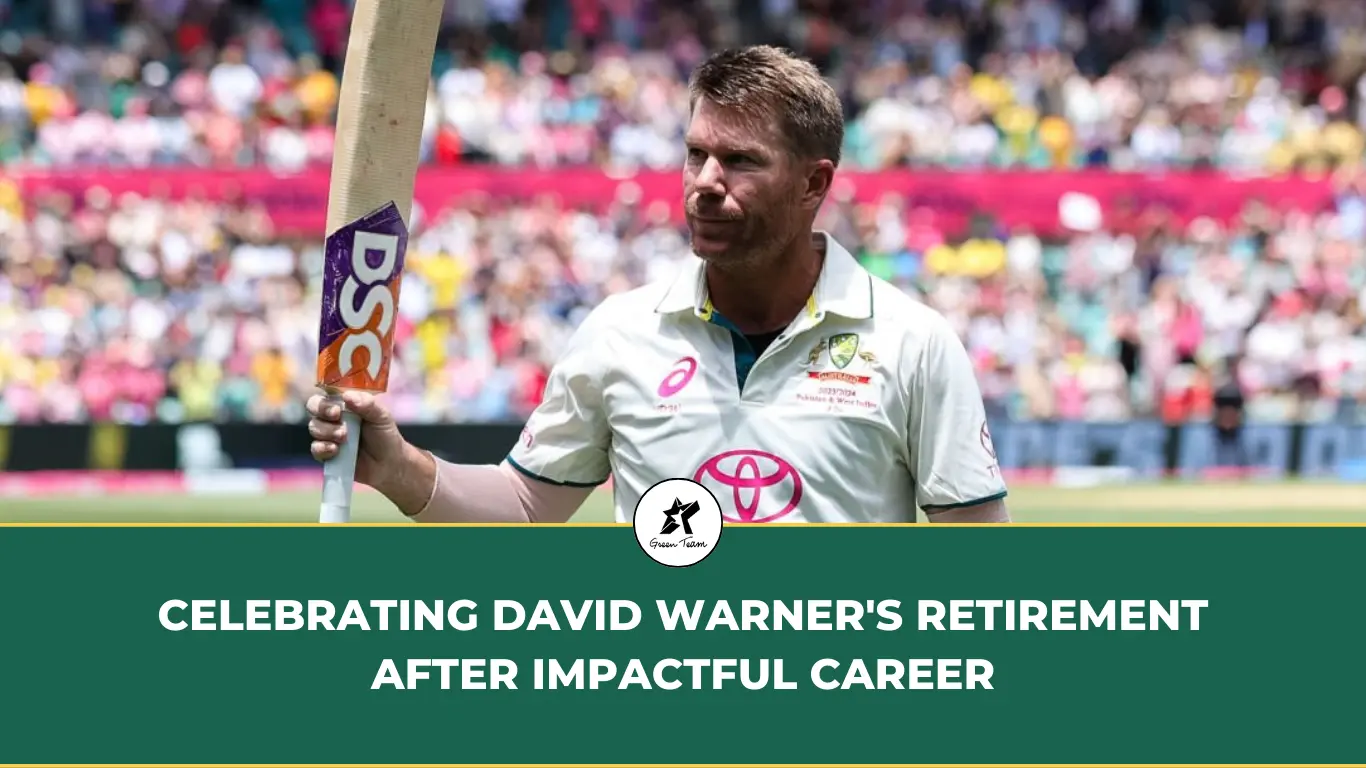
David Warner’s retirement is the hot topic of discussion in the cricket realm as the dynamic Australian cricketer, bids farewell to Test and ODI cricket. He is leaving behind a legacy that transcends the shadows of the infamous ball-tampering scandal in 2018. His retirement marks the end of an era, characterized by explosive batting, tenacity, and a persistent commitment to the sport.
Warner’s cricket journey began with a remarkable distinction – he became the first Australian since 1877 to make his international debut before playing first-class cricket. This unconventional start set the tone for a career that would be defined by solidity and a tenacious pursuit of excellence.
In the Test arena, Warner made got his baggy green against New Zealand in 2011. Although he couldn’t make a significant impact in the first Test, the second match of the series saw him rise to prominence. Warner’s outstanding innings of 123* in the second inning earned him the Player of the Match accolade, showcasing the glimpses of brilliance that would become synonymous with his batting prowess.
His ODI debut in 2009 against South Africa marked the beginning of a journey that saw Warner amass 97 runs from four innings. Despite a relatively modest start, it was evident that Warner’s aggressive style and powerful stroke play had the potential to reshape the dynamics of limited-overs cricket.
The T20I arena witnessed the left-handed batter’s explosive entry during the same South Africa tour in 2011. In his debut T20I against South Africa, he scored an impressive 89 and claimed the Player of the Match award, setting the stage for a T20 career filled with impactful performances.
As the southpaw settled into international cricket, his statistics across all formats began to reflect his dominance. In Tests, his monumental best of 335* against Pakistan in 2019 not only etched his name in the record books but also positioned him as the second-highest individual scorer for Australia in the format, following Matthew Hayden’s iconic 380 against Zimbabwe.
In ODIs, Warner’s highest score of 179 against Pakistan showcased his ability to anchor an innings while displaying aggression when needed. In the shortest format, Warner’s T20I century of 100* against Sri Lanka exemplified his adaptability to different formats. Even David Warner’s retirement will not let the lookouts forget his contributions anytime soon.
Looking at stats on David Warner’s retirement
Now, let’s look into the staggering statistics that define David Warner’s illustrious career. In Tests, he amassed 8786 runs in 112 matches at an average of 44.59, including 26 centuries and 37 half-centuries. In ODIs, the 37-year-old accumulated 6932 runs in 161 matches at an average of 45.30, featuring 22 centuries and 33 half-centuries. In T20Is, he scored 2894 runs in 99 matches at a strike rate of 141.30, with one century and 24 half-centuries.
Beyond international cricket, Warner’s contributions to first-class cricket and List-A cricket have been substantial. With 34 centuries in first-class cricket, he accumulated 11265 runs at an average of 45.60. In List A cricket, the batter scored 8886 runs at an average of 44.43, featuring 28 centuries.
As far as the T20 format, Warner’s impact is undeniable, with 11695 runs in 356 matches at a strike rate of 140.61. His ability to adapt and excel across formats positions him as one of the modern greats in Australian cricket.
As David Warner’s retirement approaches in Test and ODI cricket, the numbers and memories he leaves behind attest to an extraordinary career. While controversies may have momentarily marred his journey, his on-field achievements and unflagging commitment to the sport will be etched in cricketing history, ensuring that the name David Warner resonates as a symbol of resilience, talent, and a true cricketing maestro.
Also, see: