If there is anything that really separates cricket from other sports like the FIFA World Cup, it’s how they approach their tournament formats. And the late tweets recently divided the fans, especially on how the ICC approached the new format for the 2027 Men’s ODI World Cup. So what changes did the ICC make? Here I will explain how the new formats for ICC tournaments work and whether it is a good solution for the long term.
For the longest time, especially for the ODI tournament, there have been many different formats to see what really makes the World Cup an event for teams. The highest number in the ODI tournament has ever been 16 teams. A format on paper looks so good, but it has risks. And such was an example of the only time the tournament was played in a 16-team format was in 2007. It was a format that divided 16 teams into 4 groups, with the top two sides qualifying for the Super 8s, a round robin where every team would play against each other.
Also Read: PCB unveils major changes, new contract model with higher match fees!
It was supposed to be almost perfect. But when Pakistan and, most importantly, India were eliminated in the group stage itself, the tournament momentum shifted. The India-Pakistan games generate more revenue than any other games. It was a massive loss and a setback. It was one of the few key points why that format was a disaster.
The ICC reverted the format and, post-2011, made sure that India and Pakistan are slotted in the same group regardless of rankings. 2011 and 2015 had 14 teams split into two groups, while 2019 saw a big change where it was shrunk down to 10 teams and met with criticism. This went on in 2023 as well.
But in June 2021, the ICC announced that the 2027 event will be played in a similar format to that of the 1999 and 2003 World Cups. That format is still considered a better format for the tournament by many. The tournament saw teams (12 in 1999, 14 in 2003) split into two groups, where the top three teams from each group qualify for the Super 6s. From there, the top four would go through the semi-finals. 2027 tournament was to be like that until the recent change.
New formats for ICC tournaments – ODI World Cup 2027
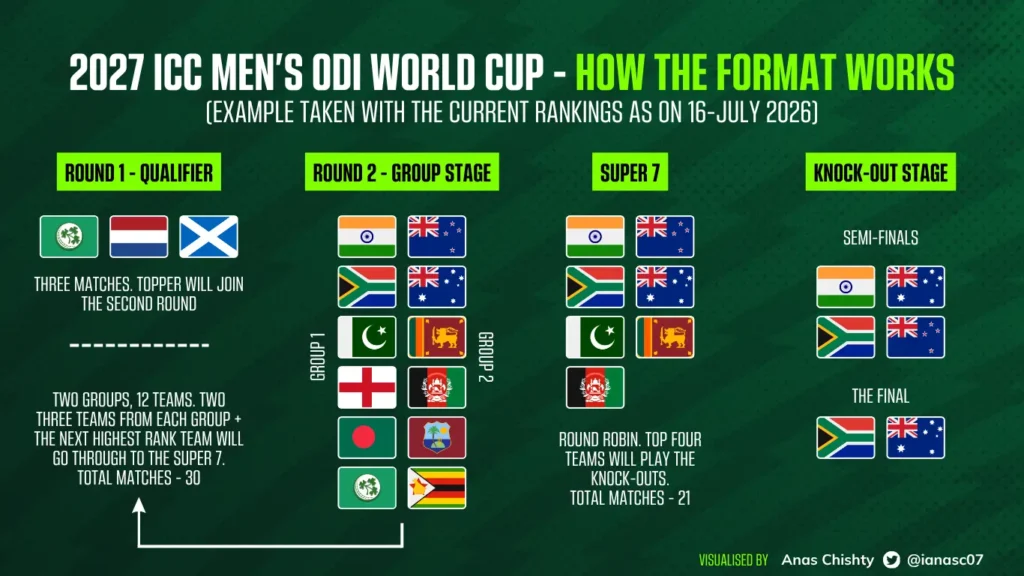
A 14-team event will be jointly hosted by South Africa, Zimbabwe, and Namibia, featuring a Super Series round before the group stages, along with a new Super 7 ahead of the semi-finals. The newly unveiled structure on Wednesday was implemented to “improve outcomes.
Teams finishing in 12th to 14th place will compete in the Super Series round. One of the three teams will advance to the Group stage, joining 11 other teams divided into two groups. The top three teams from each group, plus the next-best-ranked team overall, will qualify for the Super 7, from which the leading four advance to the semifinals.
The reorganisation follows concerns raised about the likelihood of excessive dead rubbers and subsequent stadium vacancies during the ICC’s annual conference.
New formats for ICC tournaments – ODI World Cup 2027
It wasn’t just the Men’s ODI event that had to change. Men’s T20 World Cup had also seen a tweak in the format. Though the same number of teams will be played, the group settings have differed. Men’s T20 WC have the highest number of teams participating, 20. Previously, it was four groups of five teams each, where the top two from each group played the Super 8s, also divided into two groups of four teams.
This time, they changed the group format. Instead of four groups, there will be five groups of four teams each. The top two from each group will be qualified for “Super 10s.” Now, how do five groups determine the 10 teams? The graph below (in theory) explains the process.
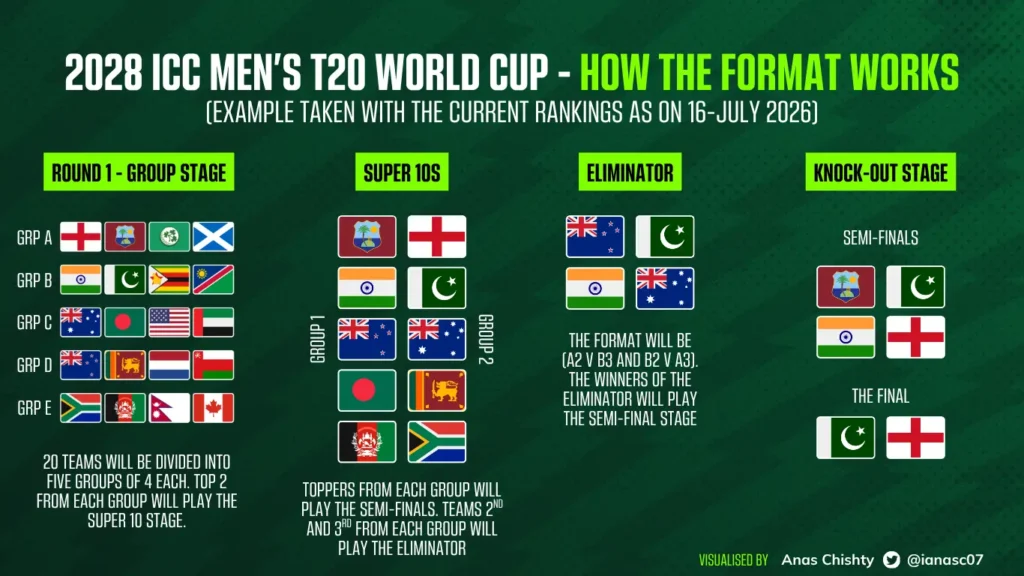
From the super 10s, we will go to the knockouts, a different style. The ICC have added “Eliminators” in the knockouts. The top team from each group in Super 10s will directly play the semi-finals, while teams 2nd and 3rd from each group will play the Eliminators (in 2v3 and 3v2 format). The winners will complete the Semi-Final pathway. The road to the final will be the same.
This style has created an interesting dynamic for the shorter format, as to how league cricket is played. The modified structure for the tournament aims to boost the count of teams in the competition’s second phase, ensuring greater representation of developing teams in the Super 10 round. The 2028 edition is to be co-hosted by Australia and New Zealand.
Whether this format will continue for the next events after these or not will depend on the revenue and public interest. The tournaments, according to the new formats, are not long, and the matches are enough for a good one-and-a-half event. But for now, this is the tournament’s structure, and it has already met with mixed criticism, especially for the Men’s ODI event.
Read More: