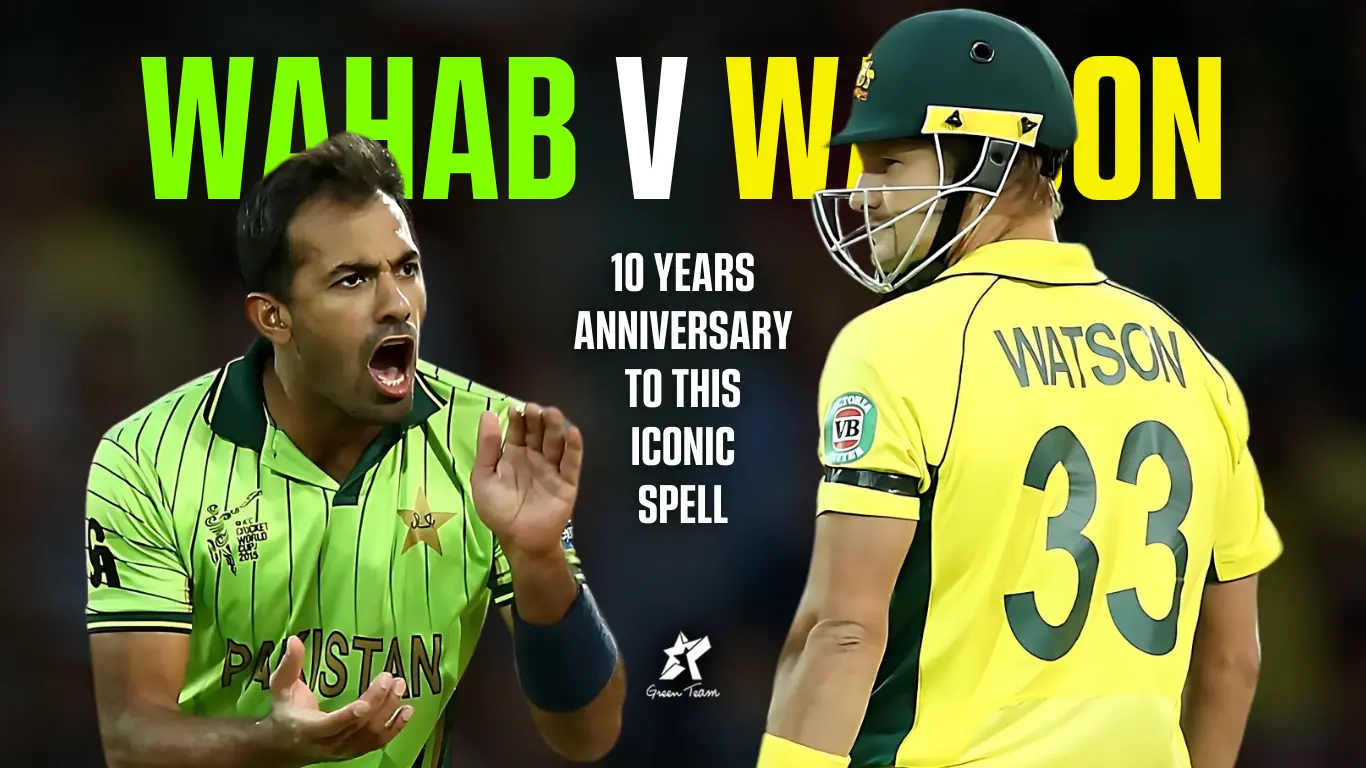
10 years have gone by. But it feels like it was just a couple of years back. Many of us teens are now grown adults, who can only sit back and reminisce the spell that was considered the best of the 2015 Cricket World Cup. But back in that day, as a teen, it was a spell that would inspire a lot of young fast bowlers. Wahab v Watson Recap is just another reminisce, but it brings back some good yet painful memories.
The build-up to a thrilling battle was simple; the 2015 World Cup was in the Quarter-Final stage. South Africa and India had won their respective games against Sri Lanka and Bangladesh. This was the third Quarter Final, with Pakistan taking on the hosts Australia in Adelaide.
Pakistan had started the tournament with two massive back-to-back losses against India and West Indies. They barely won over Zimbabwe before registering a big win over UAE to stay alive. They stunned one of the tournament favourites South Africa and concluded their group stage with a win over Ireland, confirming their knockout qualification.
Also Read: Wahab Riaz – A World Cup Performer
Throughout the tournament, it was Pakistan’s bowling that had won the games for them. Their batting was terrible and only their captain Misbah ul-Haq was the most consistent performer. It was obvious that Pakistan batters had to battle the Australian pace attack and put on a challenging total.
Misbah had won the toss and elected to bat first on a lovely condition. But immediately, Josh Hazelwood and Mitchell Starc made impacts, getting rid of the openers. Misbah and Haris Sohail rebuild. Going just at 4.5 runs per over, Misbah wanted to accelerate with the team just a touch below 100 in the 24th over. He was caught at the deep and Haris soon followed at 112-4 in the 26th. As usual, a collapse was triggered and Pakistan folded up for 213, losing their eight wickets for 116 runs.
Wahab v Watson Recap: The Drama. The Spell. The Emotions.
The drama did not begin during the bowling. It actually begin during Wahab’s batting. In the 39th over of Pakistan’s innings, Mitchell Starc sledged Wahab, who was not able to get the bat on the ball. Starc told Wahab “It’s the white thing you have to hit.” In between, Shane Watson joined the sledging and taunted him and Wahab was not happy with it. He goes and complains to the umpire Marais Erasmus, who shushed the Aussies.
The Spell began when Wahab dismissed David Warner via bouncer in his first over, where Rahat Ali caught him at the deep third-man boundary. Then, in his second, Wahab bounced out the Australian skipper Michael Clarke who was caught at short leg. This reduced Australia to 59-3 in their pursuit of 214. Shane Watson arrived and immediately found himself facing sharp, face-height bouncers. Embarrassing him every which way he could, Wahab ran in close to Watson and clapped in his face. And, unusual for an Australian, he had nothing to say back.
The emotions finally burst after four overs of torturing bouncers. In Wahab’s fourth over and Watson’s 16th ball, the Australian all-rounder finally managed to top-edge a bouncer to deep fine leg. At that particular moment, it looked like Wahab would burst out celebrating as if Pakistan had won the World Cup.

But that moment never happened. Rahat Ali, stationed at that fielding placement, who took a good low catch to dismiss Warner recently, spilt the easiest chance he could ever get. All the pressure that Wahab had built for Pakistan was drowned in the mud. And Watson, an hour later, hit the winning runs as he remained not out at 64 from 66 balls.
Shane Watson faced hell from Wahab’s 150+ kph bouncers. But equally, he was up to the task. Had Rahat caught it, Australia would have been under pressure at 83-4. Pakistan’s seesaw World Cup ended in a Quarter-Final defeat while Misbah and Shahid Afridi played their last game together in One Day cricket. Watson and Wahab were fined.
The spell may have been 10 years old now, but the memory will never fade away. A memory that many from around the world praised. It is one of the many “what ifs” stories in Pakistan cricket.
Read More: