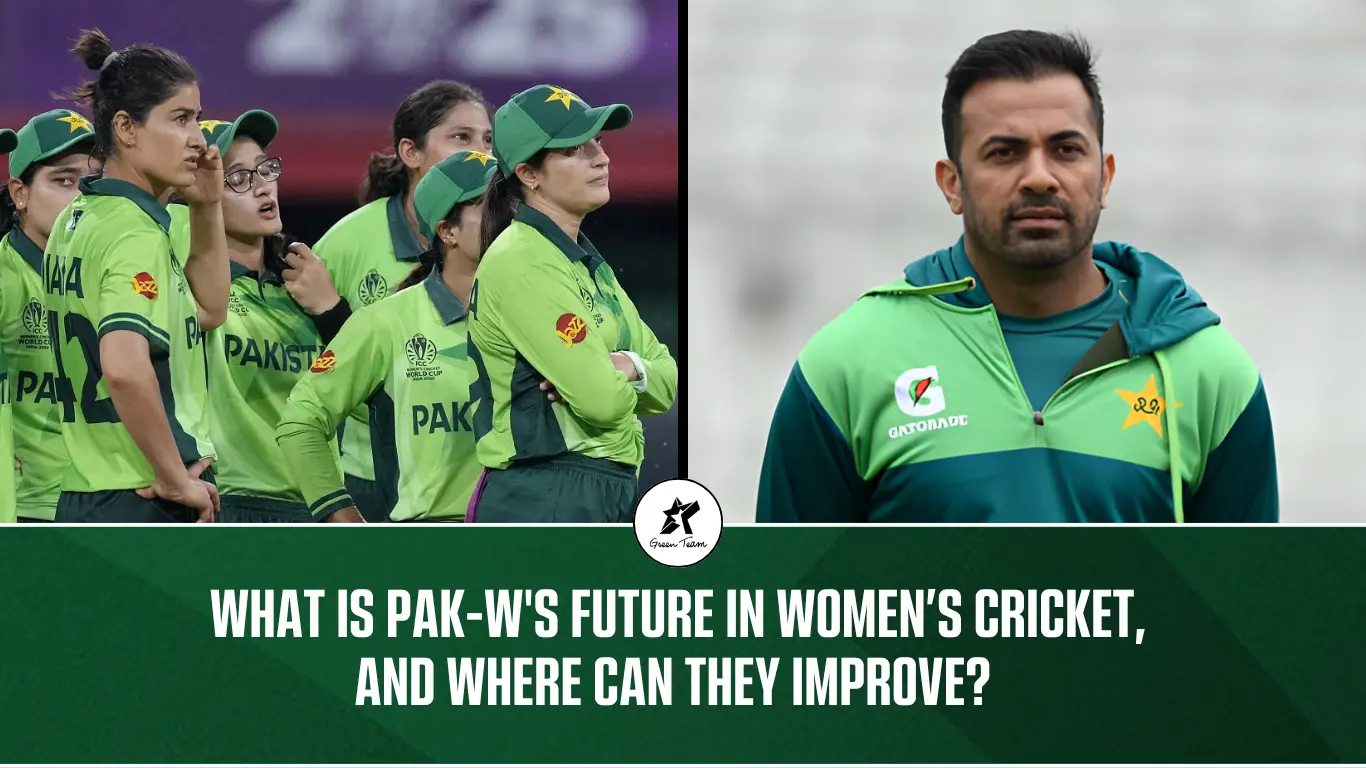
Pakistan’s women’s cricket team faces intense pressure following a disappointing performance at the 2025 ICC Women’s ODI World Cup. PCB chairman Mohsin Naqvi has allegedly mandated a comprehensive evaluation after the team’s inability to secure a victory in their initial six matches of the current ODI World Cup.
Guided by versatile player Fatima Sana, Pakistan entered the tournament with great expectations after finishing first in the ICC Women’s World Cup Qualifier. Still, their assurance swiftly deteriorated once the main event commenced.
The World Cup began with hope as the environment in Sri Lanka closely resembled that of Pakistan. Nonetheless, Pakistan’s campaign started unfavorably with a seven-wicket defeat to Bangladesh in their first game, a team they had previously beaten in the qualifiers.
Ex-Pacer and Coach Kabir Khan expressed a recurring worry, stating, “We’re not discovering new talent as effectively as other teams because they have superior domestic systems.” “We must begin at the junior level since girls in Pakistan are interested in playing professional cricket.”
As Naqvi’s review approaches, the focus is likely to turn to the absence of competitive local matches, mental resilience, and dedicated coaching assistance. For women’s cricket in Pakistan, this World Cup has been a tough yet essential wake-up call, emphasising the importance of significant, lasting change instead of temporary solutions.
PCB dismisses Wasim, appoints Wahab as Consultant
The Pakistan Cricket Board has dismissed Muhammad Wasim, the head coach of the national women’s team, following the team’s poor performance in the recent ICC Women’s ODI World Cup. PCB announced that Wasim’s contract concluded with the World Cup, and the board chose not to renew it, opting instead to hire a new head coach.
Wasim, a past Test player and former chief selector of the men’s squads, was named head coach last year.
During his tenure, the Pakistan team was eliminated in the Asia Cup semifinals and subsequently failed to progress past the league stages of the T20 World Cup earlier this year. Wasim, an experienced domestic player, had earlier led Northern to consecutive second-place finishes and a National T20 Cup championship in the 2019–20 season.
He previously held the position of chief selector for the men’s national team until his responsibilities were withdrawn during Najam Sethi’s term as PCB chairman in December 2022.
In his interim role, Wahab will oversee team matters and collaborate closely with the Director of Women’s Cricket to create plans and strategies for the future.
https://twitter.com/GreenTeam1992/status/1987199795015131148/photo/1
Furthermore, reports indicate that adjustments are occurring within the team’s support staff. Ex-Test cricketer Imran Farhat is anticipated to become part of the coaching and support team.
The PCB is expected to reveal the selection of a new head coach, along with an updated support staff for the Pakistan women’s cricket team, shortly.
Also Read: Upcoming Women’s ICC Events to be expanded
Pakistan’s disastrous performance in the Women’s World Cup
It has been noted that Pakistan-W’s performance in both ODI and T20 World Cups has been extremely poor, given how long they have been playing cricket.
In Women’s ODI World Cups, they have a win percentage of just 8.82, the second lowest among 16 teams that have participated in the event. They have played 37 matches and won just three games. Their second tournament, in 2009, is the only tournament where they progressed from round one and won two matches, their most in a single event.
Below is the breakdown of their record in each tournaments;
| Year | Played | Won | Lost | NR/T | POSITION |
| 1997 | 5 | 0 | 5 | 0 | 11TH |
| 2009 | 7 | 2 | 5 | 0 | 6TH |
| 2013 | 4 | 0 | 4 | 0 | 7TH |
| 2017 | 7 | 0 | 7 | 0 | 8TH |
| 2022 | 7 | 1 | 6 | 0 | 8TH |
| 2025 | 7 | 0 | 4 | 3 | 8TH |
| 37 | 3 | 31 | 3 |
In the Women’s T20 World Cups, Pakistan have a win percentage of just 25.71, again the second lowest among 12 teams that have participated in the shortest tournament. They have played 36 matches and won nine games. Their best tournament came in 2016, winning two matches out of four. They could have won three and qualified for the knockouts, had they not lost a close match to the West Indies in their opening game.
Below is the breakdown for the T20I tournaments;
| Year | Played | Won | Lost | NR/T | POSITION |
| 2009 | 3 | 0 | 3 | 0 | 8TH |
| 2010 | 3 | 0 | 3 | 0 | 8TH |
| 2012 | 4 | 1 | 3 | 0 | 8TH |
| 2014 | 5 | 2 | 3 | 0 | 7TH |
| 2016 | 4 | 2 | 2 | 0 | 6TH |
| 2018 | 4 | 1 | 3 | 0 | 8TH |
| 2020 | 4 | 1 | 2 | 1 | 7TH |
| 2023 | 4 | 1 | 3 | 0 | 8TH |
| 2024 | 4 | 1 | 3 | 0 | 8TH |
| 35 | 9 | 25 | 1 |
What is Pakistan’s Future in Women’s Cricket, and where can they improve
From the look at both of the events, it is very clear that the T20I suits the Pakistan-W team. But they need to improve their records across both events. To be treated as a minnow in international events is already disappointing. Given the rich history of cricket in the country, there should have been far better improvements. But there have been the same mistakes over and over again.
There’s a lack of strike rotation when it comes to batting, often putting a risk of not scoring competitive totals or having no power hitters, which can change the games entirely. Fielding can be poor at certain times, where often simplest of catches are dropped.
The best way to get exposure to modern cricket is to play women’s leagues. No offence to the domestic cricket, but that will never help improve their game. Through a combination of commercial funding, fan involvement, and enhanced infrastructure, league cricket benefits women’s cricket by raising awareness, generating professional possibilities, and fostering talent development.
These leagues enable players to hone their skills via consistent competition, establish themselves as household names, and generate substantial sponsorship and broadcast revenue, all of which eventually spur additional expansion and raise the bar for the global game.
In contrast to earlier irregular possibilities, professional leagues offer players contracts that provide both regular, high-level competition and financial security. Players get the opportunity to train and compete against elite players from all over the world, which helps them develop their abilities and comprehend various playing philosophies.
Then again, you have to be talented and a performer to be picked in the leagues. Unlike men’s PSL, there are no local leagues where overseas players can come and change their mindset or make them understand that their understanding of the ‘modern’ cricket is far behind. In fact, Pakistan-W’s team, alongside Bangladesh and Sri Lanka, are really behind the modern women’s cricket.
Unless these points that have been mentioned are taken care of, they cannot improve at this level. One might think of taking help from the Men’s team to at least make some sort of improvements.
Read more: