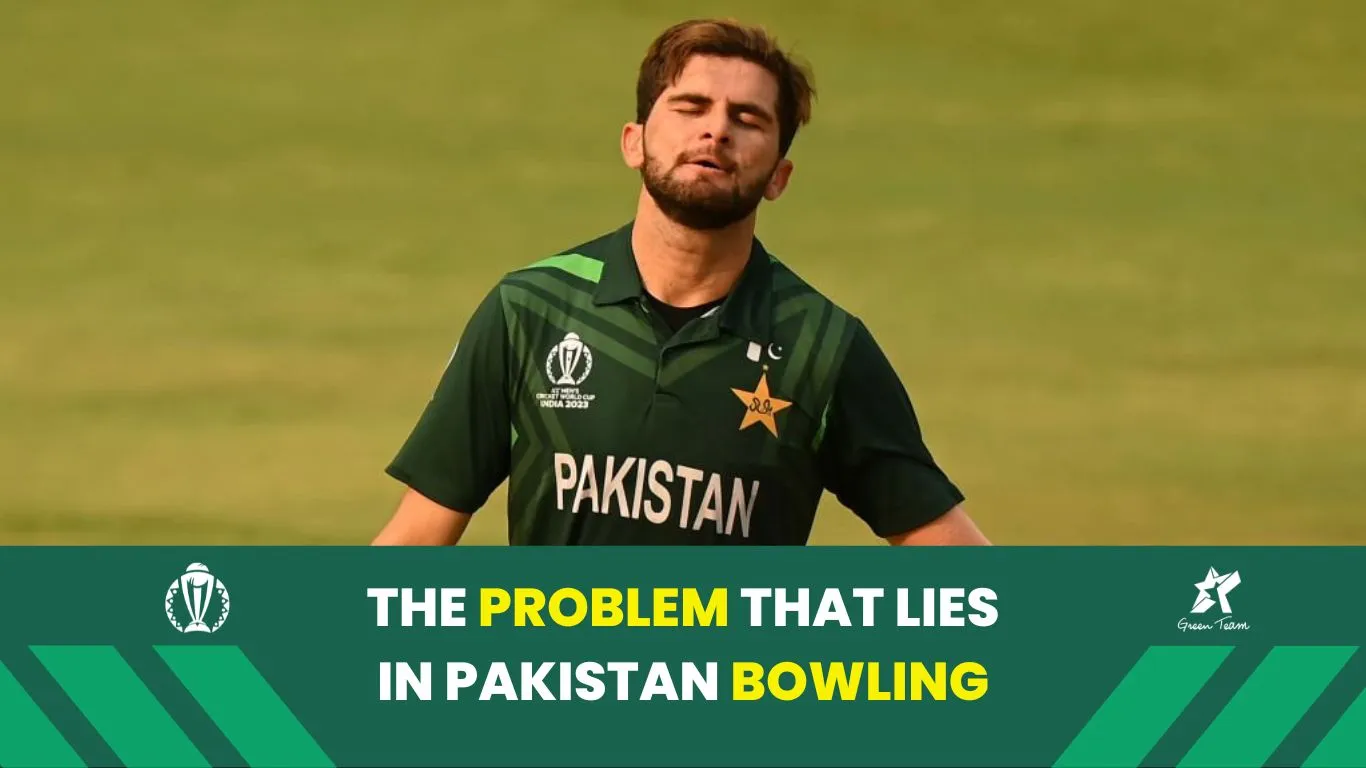
Can Babar Azam and his men still qualify for the semi-finals with Pakistan’s bowling attack?
An optimistic fan would say yes, given Pakistan’s history of making a comeback from behind. But a realistic fan would say otherwise, given how abysmal performances were shown by the national team’s attack that was exposed in the Asia Cup last month.
The fast bowlers are not striking as they should. They wait for the batters to make a mistake and get out. The spinners are horrible. They are inconsistent with their line and length. Everything about the attack tactics from Shaheen Afridi to Shadab Khan has been questionable.
What’s more, Babar Azam has never been so clueless about handling his bowlers. The Afghanistan game was perhaps the worst bowling rotation done by the skipper. In the moments where he needed to attack with the pace, he kept going back to his leg-spinners, who have been so horrible in this tournament.
Let’s have a little breakdown of Pakistan’s bowling against the rest of the teams.
Also Read: Babar Azam’s failures in tournaments; How big has this affected the Pakistan team?
Pakistan’s bowling vs the rest in 2023 WC
This ODI World Cup was expected to be a high-scoring tournament. India as host in the past few years has had a bilateral series that has seen scores over 330+ as a par.
And the tournament showed that too. Most of the bowling teams struggled especially with the likes of England and Australia with better pace attacks or Afghanistan with spin attacks. Here’s the average per wicket for each team in the tournament.
| Teams | Average | Economy | Highest | Lowest |
| Sri Lanka | 52.08 | 6.81 | 428 | 262 |
| Bangladesh | 42.57 | 5.99 | 364 | 156 |
| England | 42.60 | 6.46 | 399 | 227 |
| Pakistan | 42.24 | 6.32 | 367 | 205 |
| Afghanistan | 41.93 | 5.78 | 288 | 215 |
| Netherlands | 33.68 | 5.66 | 322 | 207 |
| Australia | 33.09 | 5.68 | 311 | 209 |
| New Zealand | 26.43 | 5.07 | 282 | 139 |
| India | 25.89 | 4.91 | 273 | 191 |
| South Africa | 24.81 | 6.09 | 326 | 170 |
In Pakistan’s case, however, is different. These poor performances have been disappointing for a team that has long been labelled as the “best bowling attack in the world,” these poor performances have been disappointing. The attack was exposed shortly after Naseem Shah suffered a shoulder injury and hence they could not cover.
To take a deep look, we further break them into a “pace vs spin” comparison.
Pakistan’s bowling: Pace vs Spin
| Bowling type | Wickets | Runs conceded | Average | Economy | Strike rate |
| Pace | 26 | 776 | 29.85 | 6.26 | 28.62 |
| Spin | 6 | 602 | 100.34 | 6.27 | 96.5 |
| Overall | 32 | 1378 | 43.06 | 6.26 | 41.34 |
Pace bowlers – What have they done?
While the pacers are the only ones who managed to take eight or more wickets across five games each, with Shaheen Afridi leading the side with 10 scalps, there is a bigger question of whether they have the ability to take wickets by themselves upfront.
The pace bowlers have to wait for the batters to make mistakes and throw their wickets away. That has been a case of late. And this calls a point that despite Usama Mir dropping David Warner’s catch in the AUS-PAK game, why haven’t the Pacers still tried to get them earlier?
They only picked wickets when the batters looked for bigger shots. Not taking anything away from his excellent five-wicket haul, but Shaheen got the rest of the wickets when batters were looking to go big in the back end. Even in the India game, he got wickets when both Gill and Sharma were looking to accelerate to increase their NRR.
Shaheen tends to be very moody when doesn’t bowl well with one line and length. He needs to remain calm and keep things simple instead of overdoing it.
Hassan Ali hasn’t done anything remarkable with the new ball either. And neither does Haris Rauf, who has an economy a touch below seven. Haris has been a run machine for the green team. He started off by conceding more than 10 runs per over on multiple occasions. Both the right-arm fast-bowlers only got the majority of wickets when the batters looked for big shots.
It’s a sight of big worry for a country that produced some of the greatest fast bowlers in their history.
Also Read: Is Hasan Ali’s Selection the right choice?
Spin bowlers – the main problem
The problem majority lies in the spin department. The breaks not being provided by your main spinners have been a major issue. Shadab Khan (6.42), Mohammad Nawaz (5.80) and Usama Mir (8.05), the frontline spinners, have not been able to remain economical throughout the tournament. And while all the spinners’ strike rates are no less than 84, only Iftikhar Ahmed – a part-timer – has done extremely well with an economy of just above five.
Shadab has been the most disappointing one. One of the experienced campaigners among the Pakistan team, his role as a bowler has been very displeasing. His line and length have been so poor that he could not bowl a consistent line and length. Every couple of deliveries, he bowls a low full toss which completely ruins the over.
There has been no control, no varieties presented and most importantly, no sharp spin. Even without spin, one maintains proper control in his bowling. And while Iftikhar is not a big turner of the ball, he has done very well in bowling all because of bowling at consistent line and length and that too being a part-timer.
It shows how further it is disappointing given that Shadab and Nawaz, who have been with the Pakistan team for over seven years, haven’t been able to stand up as experienced players.
With Pakistan now required to win all of their remaining matches (something that is so common that fans are still hoping for some miracle), they need to sort out their bowlers’ tactics as soon as possible. Or has it been too late already? Given that they were exposed a month before the tournament began?
Read More: