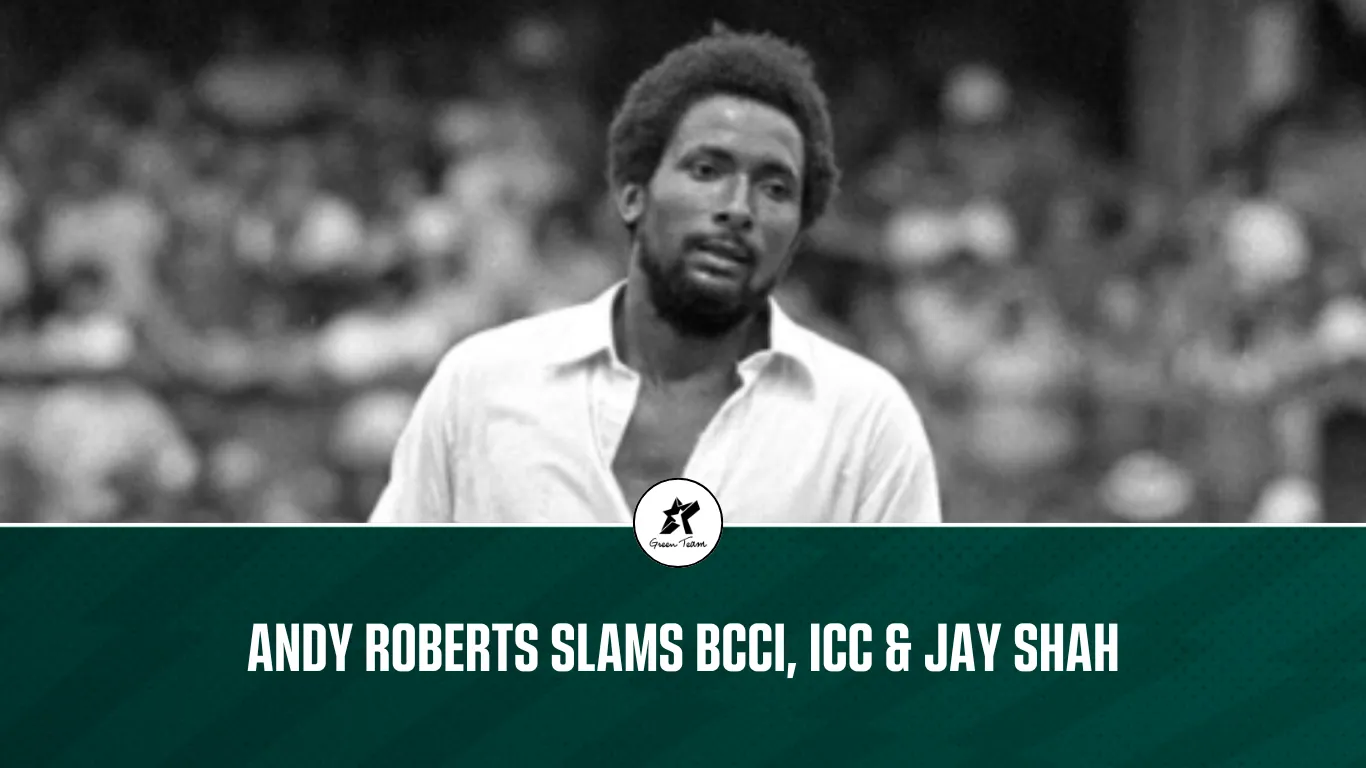
Is the ICC Favoring India? Andy Roberts Calls Out Scheduling Bias
West Indies cricket legend Sir Andy Roberts has ignited a major controversy with his scathing criticism of the International Cricket Council (ICC) and the Board of Control for Cricket in India (BCCI). Known for his blunt views, Roberts has accused the ICC of favouring India in major tournaments, claiming that the playing field is far from level.
His comments come after India’s back-to-back title wins in the 2024 T20 World Cup and the 2025 ICC Champions Trophy, where he alleges India enjoyed unfair advantages.
Andy Roberts’ Bold Accusations
In a recent interview, Roberts directly criticized the ICC for allegedly favouring India, particularly in major tournaments. He pointed to the 2025 ICC Champions Trophy, where India played all their matches in Dubai, avoiding travel, while other teams had to adjust to different venues.
According to Roberts, this unfair scheduling gave India a significant edge, making the tournament look like a “one-nation competition.”
He also referenced the 2024 T20 World Cup, claiming India had prior knowledge of their semi-final venue in Guyana, giving them an unfair advantage over other teams.
Andy Roberts’ Comments
In a candid interview, Roberts didn’t mince words. He blamed the ICC for allowing India to dominate global cricket, both on and off the field. He made some striking quotes and raised a concern. He made some striking statements and raised serious concerns about the fairness of international cricket.
India’s Scheduling Advantages
Andy Roberts criticized the ICC for allowing India to play all their matches in a single venue during the 2025 Champions Trophy. He argued that this gave India a significant advantage over other teams that had to travel between different locations.
“At the Champions Trophy, India did not have to travel. How can a team not travel during a tournament? It is not fair, it’s not cricket.”
ICC’s Alleged Bias
Roberts accused the ICC of operating under the influence of the BCCI, suggesting that India dictates major cricketing decisions. He claimed that if India wanted changes in fundamental rules, the ICC would comply without hesitation.
“To me, the ICC stands for the Indian Cricket Board. India dictates everything. If tomorrow, India says, ‘Listen, there should be no no-balls and wides,’ take my word, the ICC will find a way to satisfy India.”
Advantage in the 2024 T20 World Cup
He alleged that India had prior knowledge of their semi-final venue in the 2024 T20 World Cup, which gave them a strategic advantage over their opponents. This, according to Roberts, raised serious questions about fairness in ICC tournaments.
“India even had an advantage at last year’s T20 World Cup, where they knew in advance where their semi-final would be played [in Guyana].”
Cricket Becoming a “One-Nation Sport”
Expressing concern over India’s growing dominance, Roberts warned that international cricket was becoming increasingly uneven in favour of one nation. He emphasised that financial influence should not dictate the integrity of the game.
“I know a lot of money comes from India, but cricket should not be a one-country sport. It now looks like a one-nation competition, and the playing field is not level.”
The Controversy: India’s Alleged Advantages
Andy Roberts’ accusations highlight growing concerns about favouritism in ICC tournaments. He pointed out that during the 2025 Champions Trophy, India played all its matches in Dubai, while other teams had to travel between venues. This allowed India to settle in one location and avoid travel fatigue, giving them a clear advantage.
Also, he claimed that India had prior knowledge of their semi-final venue in the 2024 T20 World Cup, which raised questions about transparency. The ICC’s decision to relocate India’s matches from Pakistan to neutral venues further fueled accusations of bias and favouritism.
A Pattern of Favoritism?
Roberts’ comments reflect broader concerns about the BCCI’s influence over the ICC, with critics arguing that India’s financial power gives it undue control over global cricket decisions. The BCCI’s massive contribution to ICC revenue allegedly allows it to influence key policies, while India often benefits from favourable scheduling with minimal travel.
Also, the ICC’s willingness to relocate India’s matches has raised concerns about fairness and neutrality. According to Roberts, these factors are transforming cricket into a sport where power and money dictate the rules, rather than fairness and competition.
Mixed Reactions from the Cricketing World
Roberts’ remarks have sparked divided opinions in the cricketing world. Supporters, including former cricketers like Michael Holding and Shoaib Akhtar, back his concerns and call for greater transparency in ICC decisions.
On the other hand, opponents, particularly Indian supporters, argue that India’s success is a result of cricketing excellence rather than favouritism.
Is Cricket Losing Its Global Balance?
Roberts’ biggest concern is that cricket is turning into a “one-nation sport,” dominated by India. He argues that the ICC’s dependence on the BCCI’s financial power is compromising the game’s integrity.
To maintain its credibility, the ICC must take steps to ensure fairness in international cricket by implementing transparent scheduling, providing balanced revenue sharing to support smaller cricketing nations, and establishing independent governance to minimise the influence of powerful boards.
Andy Roberts’ statements have reignited the debate on neutrality, raising a critical question for fans: Is cricket truly a global sport, or is power dictating the rules?