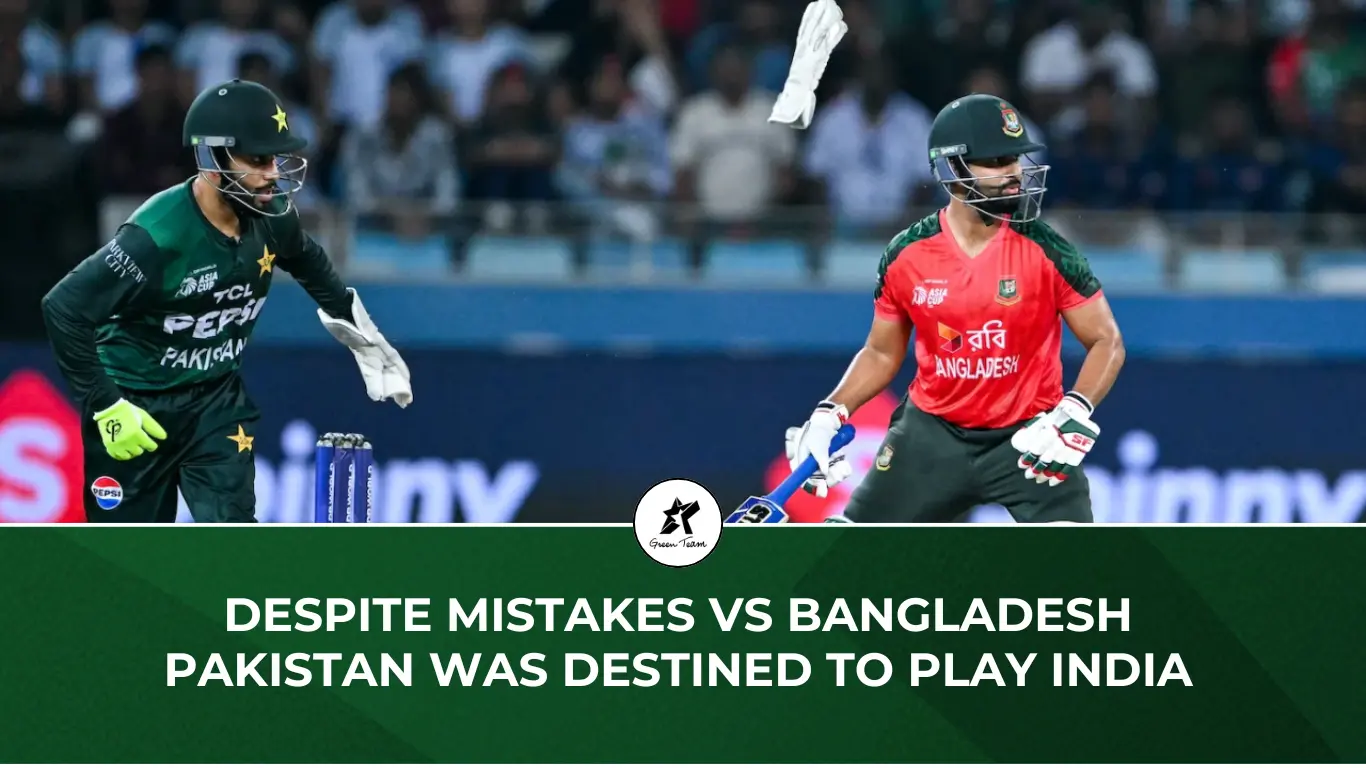
After stumbling and tumbling to a below-par 135, the Pakistan bowlers were right on the money. They delivered an 11-run victory against Bangladesh to set up a date against India for the first time ever in an Asia Cup final.
Despite not being in form as a batter, Salman Agha showed immense character and tactical maturity to choke the Tigers and ensured that Pakistan beat Bangladesh in this virtual semi-final at the Dubai International Cricket Stadium.
Powerplay woes, middle-over lows, death-over blows as Pakistan beat Bangladesh
As has been the norm for most parts of the Asia Cup, the Pakistani batters were not able to take full advantage of the powerplay and ended up scoring merely 27/2 in the first six overs.
It all started with the dismissal of Sahibzada Farhan, who clipped one to the point fielder, and Saim Ayub chipped it straight to mid on to extend his abysmal run in this tournament.
The men in green played as many as 22 dot balls as neither Fakhar Zaman nor Salman Agha could force a move on.
Statistically, Pakistan has been the worst side in the powerplay in the super fours, scoring at just 7.17 rpo, as compared to Bangladesh (7.75), Sri Lanka (8.92), and India (11.46). Only the teams that were eliminated in the group stage were worse than the men in green.
The middle overs were also no different as Pakistan continued to lose wickets and the run rate kept getting lower and lower.
Fakhar tried hard, throwing his bat at almost every ball, and ended up hitting one straight to wide long-off’s throat. Post this dismissal, the captain tried building a partnership with wicketkeeper Mohammad Haris but ended up getting a faint edge to make matters worse for the Pakistan side.
However, following a few reprieves and a couple of lusty blows from Shaheen Shah Afridi gave Pakistan a bit of momentum until his luck finally ran out and skied one into the hands of Bangladesh captain, Jaker Ali.
Pakistan’s best phase of the innings was easily the last 5 overs of the innings as Mohammad Nawaz scored 25(15) at a brisk rate while Haris also played a vital 23-ball 31 to ensure Pakistan ended up with a respectable total.
Even though the duo was dismissed with 10 balls to go, Faheem Ashraf ended up with a crucial 14-run cameo as the men in green ended the innings with 135, 52 of which came in the last five overs of the innings.
Pacers fire, spinners inspire as Pakistan beat Bangladesh
The onus was on Shaheen Shah Afridi with the new ball in hand to do what he does best, and that is to get wickets – and he did not disappoint as the left-armer got the wicket of Parvez Hossain Emon, who tried to go for the big shot but ended up getting more height than distance.
Meanwhile, the in-form batter Saif Hasan looked in good touch yet again as he struck a couple of sixes and a four to keep the scoreboard ticking and run rate in check. His partner at the other end, Towhid Hridoy, then skied another one right into Saim Ayub’s hand as he looked to attack Shaheen Afridi after Saif survived a close run-out call a ball before his dismissal.
However, what ensued in the next over was something that brought back some pleasant memories for the Pakistan fans watching. Haris Rauf’s pace troubled Saif Hasan as he was late to the delivery and ended up getting a thick edge to Saim Ayub at point – the resemblance between this and Mohammad Amir’s dismissal of Virat Kohli in the Champions Trophy 2017 final was uncanny.
Following the end of the powerplay, Salman Agha brought on the spinners to apply the choke and make run scoring difficult for Bangladesh in the chase of a modest 136.
Pressure finally got to the Bangladeshi batters as Nawaz, Abrar, and Saim were accurate with their lines and lengths. Nawaz, was the first spinner to draw blood as Mahedi Hasan tried to go inside out over cover, just to find Hussain Talat on the offside. A few overs later, Saim joined the party as the youngster intelligently bowled a carrom ball away from Nurul Hasan, who hit one down to the long off fielder.
As wickets kept falling, Shamim Hossain remained a constant as he rotated strike well and even struck a few sixes off Abrar Ahmed’s bowling to keep his side in the contest, heading into the final phase of the innings.
But that is where, Shaheen was brought on. It was the 25-year-old’s last over of the match as he had bowled 3 on the trot in the powerplay – and being the clutch player that he is, the left-armer deceived Shamim with a slower short ball, who expected a quick one and got into position to play a ramp short but it only went as far as Talat’s hands at point.
After that, Haris Rauf got two wickets in the 18th over – and survived an injury scare – to all but ensure Pakistan’s victory. Rishad Hossain tried his level best to somehow manage something special even while needing 18 off 3 balls, but it was not to be as Pakistan beat Bangladesh in a thriller.
What’s next for the men in green?
After 40 years and 17 Asia Cup editions, Pakistan beat Bangladesh to set a date against India in the final of an Asia Cup for the first time ever, despite being at their flawed, human best throughout the tournament.
What would be motivating for Pakistan is the fact that in all-format tournaments with four or more teams, Pakistan-India have met 5 times in a final, with the green shirts claiming victory in three of them.
One of those victories is the CT 2017 win, and even then, a young Pakistan side was up against arguably the best Indian sides in recent times, and so will be the case on Sunday.
The Shaheens have the opportunity to write the wrongs and make the Pakistani fans forget about the earlier losses against the men in blue, by beating them and lifting the Asia Cup for the third time. It certainly doesn’t get any bigger than this.