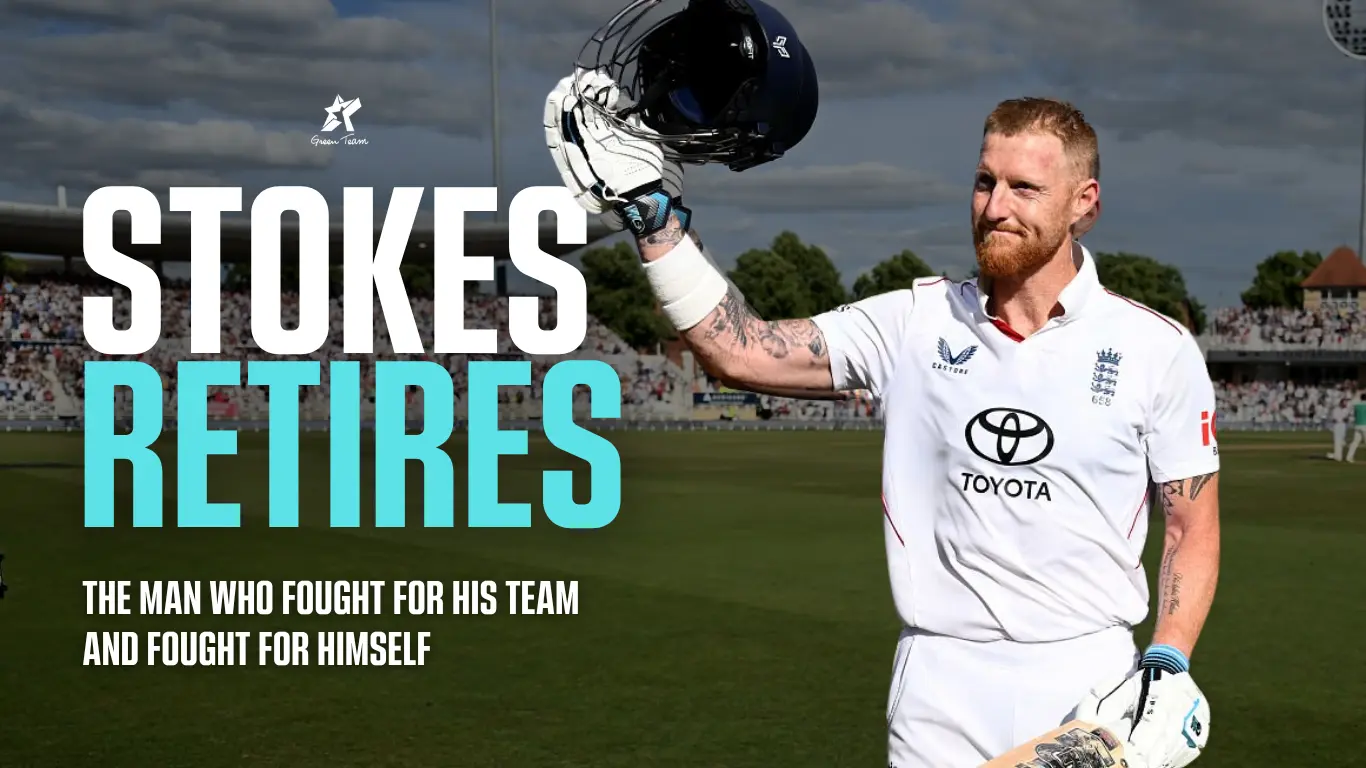
Let’s admit it, none of us wants him to leave just now. It was just too sudden. But Ben Stokes’ retirement made a shocking one. And to the public, it was not revealed until the 4th day of the ongoing series against New Zealand.
It was an emotional moment, with Stokes signing off with a wicket (the moment it was revealed to the public) and a quick-firing 30 coming as an opener. Unfortunately, England couldn’t chase 373 as Stokes ended his career with a series loss. Though what he has achieved throughout the years will not be forgotten.
We look at the legendary career of the madman who fought for his team and for himself.
Ben Stokes’ Retirement: History and Early Career
Ben Stokes was born on June 4, 1991, in Christchurch, New Zealand, to parents Gerard and Deb Stokes. His father was a rugby league player and coach by profession, whereas his mother was employed in the field of education. Raised in a sports-oriented family, Stokes was exposed to competition early on. Despite being born in New Zealand, Stokes grew both personally and as a cricketer in England.
During his teenage years, Stokes swiftly gained recognition for his athletic talent and bold approach to the game. He represented Cumbria at the youth level before entering Durham’s academy, where his strong batting, intense fast bowling, and outstanding fielding drew the interest of national selectors. His coaches appreciated his great talent but also understood that his intense temperament would require management for him to achieve success at the top level. Nevertheless, his enthusiasm and drive identified him as one of England’s most promising young talents.
Early Career and Fighting Century
Stokes began his international career for England in limited-overs cricket in 2011, but it was in the 2013-14 Ashes series in Australia that he really made a name for himself in the cricketing world. England experienced one of the bleakest moments in their Ashes history, facing a shameful 5-0 defeat to Australia. Despite the letdown, the young all-rounder delivered a performance that shone brighter than any other.
During the third Test in Perth, Stokes achieved a brave 120, marking his first Test century, against a top-tier Australian bowling lineup. Batting with outstanding assurance as wickets fell around him, he would not give up and launched a counterattack with bold hitting. Despite England’s defeat in the match and the series, Stokes’ century was viewed as the rise of a potential future superstar.
In the following two years, his growth progressed swiftly. He evolved into a progressively reliable member of England’s Test team, making contributions with bat and ball. In January 2016, he delivered one of the greatest innings of his career by scoring 258 against South Africa in Cape Town. Achieving his double century in remarkable style, Stokes marked the second-fastest double century in Test history.
Also Read: Martin Guptill Retires: A 13-Year Legacy Comes to an End
Ben Stokes’ Retirement: post-2015 WC transformation and heartbreaks
England’s underwhelming performance in the 2015 ICC Cricket World Cup became a pivotal moment for the national team. Their premature exit compelled English cricket to let go of its traditional approach and adopt an assertive, aggressive style centred on bold batting and a positive mindset. Few players gained more from this change than Ben Stokes.
Rather than being overly careful, he was motivated to strike from the beginning, letting his dynamic batting shine. His confidence increased significantly, as his bowling became quicker and more intense. Along with his exceptional athletic ability on the field, Stokes developed into one of the top all-rounders globally. By the conclusion of 2016, he had emerged as one of England’s most important players and was highly regarded as one of the best cricketers in global cricket.
2016 Heartbreak and 2017 Suspension
Even after securing his place among the top players globally, 2016 and 2017 presented some of the most challenging times of Stokes’ career. In the championship match of the 2016 ICC Men’s T20 World Cup against the West Indies, England needed only 19 runs to defend in the last over. Captain Eoin Morgan assigned Stokes the task of delivering those critical six balls. In a remarkable finish in cricket, Carlos Brathwaite hit four back-to-back sixes, clinching the win for the West Indies and leaving Stokes heartbroken. The painful loss tormented him for years, and many doubted if he would ever completely heal from the emotional weight of that last over.
The year that followed brought yet another significant challenge. In September 2017, Stokes was engaged in a street fight in Bristol, leading to his suspension from playing international cricket. The event caused him to miss the Ashes series in Australia and raised questions about his future with England. Despite eventually being acquitted in court, the controversy harmed his public reputation and disrupted what was becoming a swiftly advancing career. Throughout this challenging time, Stokes encountered scrutiny from the media and the cricketing community, challenging his strength both professionally and personally.
Also Read: Carlos Brathwaite’s 4 Sixes – Reminiscing the great finishes in a World Final
Ben Stokes’ Retirement: The greatest comeback for the English all-rounder
The year 2019 changed Ben Stokes from being one of England’s top players to becoming one of the greatest legends in modern cricket. During the ICC Cricket World Cup, he repeatedly produced match-winning displays, yet his standout moment happened in the memorable final against New Zealand at Lord’s. Pursuing a challenging target amidst immense pressure, England faced significant difficulties until Stokes delivered one of the most remarkable innings in one-day international history. Staying unbeaten on 84, he led England to a thrilling tie before playing a vital part in the Super Over. England ultimately claimed the World Cup by virtue of the boundary count rule, achieving their inaugural men’s ODI World Cup championship. Stokes rightfully earned the Player of the Match title for his outstanding performance.
Just a couple of weeks later, he produced another remarkable masterpiece during the third Ashes Test at Headingley. England were pursuing a daunting target of 359 and had fallen to 286 for 9, needing 73 additional runs with just one wicket left. Exhibiting extraordinary poise, bravery, and resolve, Stokes executed a stunning counteroffensive against Australia’s bowlers. His flawless 135 achieved one of the most remarkable triumphs in Test cricket history and maintained England’s hopes in the Ashes series. By the conclusion of 2019, Stokes had achieved one of the most remarkable redemption narratives the sport had ever seen.
2022 World Cup Redemption
Six years after the heartbreak of the 2016 final, England again found themselves contesting for the world title, this time facing Pakistan. Pursuing a reasonable yet demanding goal under pressure, Stokes stayed composed during the innings and led England’s successful pursuit with a not-out 52. His calm display led England to triumph and clinched their second T20 World Cup championship title.
Earlier that year, Stokes had taken over from Joe Root as England’s Test captain. Together with head coach Brendon McCullum, he unveiled a thrilling, aggressive strategy that gained international recognition as “Bazball.” With his guidance, England embraced a bold approach to cricket that rejuvenated the Test side and rebuilt confidence following years of underperformance. His impact reached further than his personal performances, encouraging teammates to compete with freedom, confidence, and optimism.
Ben Stokes’ Retirement: End of an era and legacy
Although his final series ended in defeat, tributes from teammates, opponents, and cricket fans across the world celebrated a player whose courage, passion, and ability to deliver in the biggest moments had defined an extraordinary era of English cricket. Whether it was the nightclub incident that happened before the 2nd test against New Zealand, or whether this was indeed his pure decision, Stokes left a massive mark on English cricket.
After fifteen years representing England, he retired as one of the greatest all-rounders the country has ever produced. His career included more than 7,200 Test runs, over 250 Test wickets, two ICC World Cup titles, and countless match-winning performances that changed the course of games and series.
Legacy
Ben Stokes’ career was never defined solely by statistics or trophies. Instead, it was shaped by resilience, redemption, and an extraordinary ability to perform when the pressure was at its greatest. From his fighting century in Perth and his devastating disappointment in the 2016 T20 World Cup final to his unforgettable heroics at Lord’s and Headingley in 2019, Stokes repeatedly produced performances that became part of cricketing history.
His willingness to confront personal challenges, speak openly about mental health, and lead England into a new era of attacking Test cricket further strengthened his legacy. By the time he retired, Ben Stokes was remembered not only as one of England’s greatest all-rounders, but also as one of the most influential and inspirational cricketers of his generation.
Read More: